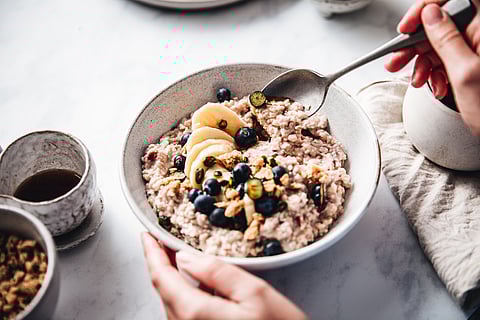

Oatmeal is a heart-healthy breakfast, which lowers LDL or bad cholesterol and blood pressure.
Photo Credit: istockphoto

Research has found that a two-day oat-only diet lowered LDL cholesterol by 10% and kept levels down for six weeks. The gut microbiome plays a key role here by producing compounds that block cholesterol buildup. While not a prescription, the study highlights oats’ powerful impact on heart health and their role as an easy dietary intervention.
Two days. No medications. Just oats. That is the premise of a study that caught the attention of cardiologists and nutritionists earlier this year and for good reason. Most of us have heard oats are good for the heart.
But 48 hours of nothing but oats dropping cholesterol levels and keeping them down for weeks? That seems a far-fetched assertion. Surprisingly, there's quite a lot of science to back it up.
In January 2026, the University of Bonn researchers published findings in Nature Communications, the esteemed scientific journal, on a controlled study investigating precisely that concept.1
The participants, all carrying what doctors refer to as metabolic syndrome, which included a collection of medical problems involving excessive weight gain, high blood pressure, elevated blood sugar, and poor cholesterol levels.
It's a widespread disorder that affects one in every three people on earth and has a substantial bearing on increasing the risk of developing cardiovascular disease.
A control group of individuals were placed on an oatmeal diet three times per day for two days, consuming 100g rolled oats per meal with water as the liquid base and minimal other additions such as fruits and/or vegetables as an accompaniment, without salt, sugar, or other additives.
They were also consuming a roughly half portion caloric diet for those two days. Another control group was put on a similar reduced caloric diet, sans the oatmeal.
The outcomes? LDL cholesterol (the bad one that that contributes to the clogging of arteries) dropped by approximately 10%, total cholesterol by approximately 8%, the test subjects were two kilos lighter on average, and blood pressure lowered slightly, whereas there were comparatively minor reductions for the control group.
The part that amazed the scientists most however was not just the findings for the two day period. It was for the days following.
Six weeks after participants finished their two-day oat diet, and had gone back to their normal diets fully, those improvements in cholesterol were still showing in their blood tests.
This is unusual for benefits lasting this long from a two-day food intervention. This encouraged the researchers to try and work out why this happened.
The key is your gut. Certain compounds, known as phenolic metabolites are produced by your gut bacteria when oats are broken down during digestion.
These metabolites appear to inhibit how your cells process cholesterol, essentially hindering the normal mechanisms that enable LDL (bad) cholesterol to build up in your body.
Put simply, you are essentially fueling your gut bacteria, which create protective compounds and tell your body to get rid of its bad cholesterol and the effects continue even after the oats have gone.
In an ironic parallel study, that same team fed subjects similar levels of oat products daily for six weeks.
The results were much smaller, showing that the acute burst of oats seems to be more effective than the smaller, continuous daily doses.
Oats have a soluble fiber known as beta-glucan. When you eat them, the beta-glucan creates a thick, jelly-like substance within your intestines.
This substance then entraps both cholesterol along with the bile acids the body needs to produce cholesterol, and the contents of bile acids, carrying them out of the body before the cholesterol can be absorbed.
According to the British Heart Foundation, just 3 grams of beta-glucan a day, alongside an all-round healthy diet, will lower your cholesterol. So that's roughly two to three 40g servings a day (1.6g of beta-glucan per serving).2
This process has been researched for many years now, but it has only been recently, thanks to University of Bonn research, that we have also discovered that it is not simply the fiber itself doing the work.
The gut microbiome plays a much larger role than previously understood, which may explain why oats eaten in concentrated doses over a short window can have an outsized impact.
The study focused on people with metabolic syndrome, so the strongest evidence applies to that group. But high LDL cholesterol is extremely common, and it often has no symptoms and goes undetected until someone has a blood test for something else entirely.
For anyone who has been told their cholesterol is creeping up, or who has a family history of heart disease, the idea that a structured two-day oat protocol could provide measurable benefit ,without a prescription, is worth taking seriously.
That said, a word of caution. The sample was tiny – a mere 32 individuals. And, severely limiting your calorie intake and consuming only oats for 48 hours is a difficult prospect for most.
Those who have diabetes, kidney disease, or any chronic health condition are warned against this kind of abrupt change to your diet without first consulting their physician.
Perhaps not as a protocol, definitely not as a rule. But the takeaway from this study for day-to-day life is a very powerful one, which is oats work.
Consumed in reasonable, significant quantities and on a regular basis, oats have a very positive function within our cardiovascular systems. One doesn't have to be limited to the contents of a bowl of oatmeal for two days straight in order to reap their benefits.
A more manageable and practical implication is the following: If you have recently been informed by your doctor that your cholesterol is dangerously high, introducing oats to your diet is one of the most practical, cost-effective, and proven changes one could make.
Plain rolled oats or porridge, not the flavored instant sachets loaded with sugar, are what the research supports.
The 48-hour intensive approach in the study is more of a scientific probe into mechanism than a prescription for daily life. Think of it less as a diet plan and more as proof of what this grain is capable of when your gut bacteria get to work on it.
Oats have been associated with heart health for a long time, but this new research from the University of Bonn, published in Nature Communications in January 2026, makes the case more specifically and more compellingly than anything before it.
A 10 percent drop in harmful cholesterol in 48 hours, with effects lasting six weeks, is certainly not a minor footnote. It is a signal worth paying attention to.
The mechanism, as researchers now understand it, runs through the gut. The bacteria that live there transform compounds in oats into protective molecules that change how the body processes cholesterol. The more oats, the stronger the response.
You do not need to live on oatmeal for two days to benefit. But you might want to stop skipping your bowl in the morning.
How does eating oats for 48 hours lower cholesterol?
Eating oats for 48 hours provides a concentrated dose of beta-glucan, a soluble fiber that forms a gel-like substance in the intestines. This traps cholesterol and bile acids, preventing their absorption. Additionally, gut bacteria break down compounds in oats into phenolic metabolites that inhibit cholesterol processing in cells, leading to reduced LDL cholesterol levels.
Is the 48-hour oat diet more effective than daily oat consumption?
According to the University of Bonn study, a short, intensive 48-hour oat diet resulted in a greater reduction in LDL cholesterol and longer-lasting effects compared to daily oat consumption over six weeks. The acute burst appears to stimulate gut bacteria activity more strongly than smaller, continuous doses.
Who can benefit most from this 48-hour oat intervention?
The study focused on individuals with metabolic syndrome, a group at high risk of cardiovascular disease due to factors like high blood pressure and poor cholesterol. People with elevated LDL cholesterol or a family history of heart disease may also benefit, but those with chronic conditions should consult a physician before attempting this diet.
What are the practical recommendations for incorporating oats into a heart-healthy diet?
Consuming two to three 40g servings of plain rolled oats daily (providing about 3 grams of beta-glucan) alongside a balanced diet can help lower cholesterol sustainably. Avoid flavored instant oat packets with added sugars and focus on whole oats or porridge to achieve cardiovascular benefits.
Are there any risks or considerations before trying the 48-hour oat diet?
Yes, the 48-hour oat diet involves a significant caloric reduction and oat-only intake, which may be difficult and is not suitable for everyone. Individuals with diabetes, kidney disease, or chronic health issues should avoid abrupt dietary changes like this without medical advice due to potential health risks.
References:
1. Nature Communications | Cholesterol-lowering effects of oats induced by microbially produced phenolic metabolites in metabolic syndrome
2. Heart Foundation | Nourish your heart with heart-healthy grains
Disclaimer: This content is for general informational purposes only and should not replace professional medical advice. Always consult a qualified healthcare provider with any questions about your health or treatment options.
At marvelof.com, we spotlight the latest trends and products to keep you informed and inspired. Our coverage is editorial, not an endorsement to purchase. If you choose to shop through links in this article, whether on Amazon, Flipkart, or Myntra, marvelof.com may earn a small commission at no extra cost to you.