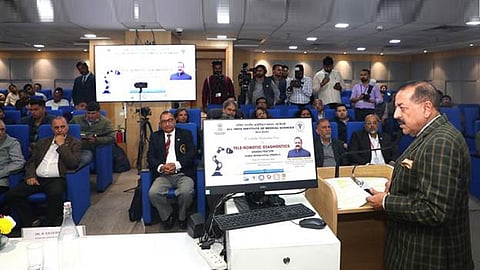


This might be tough to believe, but doctors in Delhi just did an ultrasound on someone in Antarctica. Yes, you heard that right. Highlighting the country's growth in AI-enabled healthcare and frontier science, a top cabinet minister witnessed the live demonstration of an indigenously developed Tele-Robotic Ultrasonography (TUS) system.
The new system has been developed by a team of researchers at the All India Institute of Medical Sciences (AIIMS), New Delhi, and the Indian Institute of Technology (IIT), New Delhi, in association with the National Centre for Polar and Ocean Research under the Ministry of Earth Sciences (NCPOR).
With the new system, a doctor in AIIMS successfully conducted a real-time ultrasound examination of a volunteer located in Maitri Station Antarctica, which is over 12,000 km away from India.

Dr. Jitendra Singh, Union Minister of State (Independent Charge) for Science & Technology; Minister of State (Independent Charge) for Earth Sciences; and Minister of State in the Prime Minister’s Office, Ministry of Personnel, Public Grievances and Pensions, Department of Atomic Energy, and Department of Space, witnessed the event live.
"Emerging technologies such as telemedicine, AI-driven diagnostics, and robotic intervention can bridge this gap and redefine clinical practice in the coming years," the minister said at the event.
According to the Press Information Bureau (PIB), the robotic arm in the Tele-Robotic Ultrasonography (TUS) system is equipped with an ultrasound probe that offers six degrees of freedom and replicates the precise hand movements of an expert sonographer.
The system uses force-sensing safety features and delivers reliable imaging with less than a one-second delay, enabling emergency-focused assessments such as FAST scans, abdominal organ evaluation, cardiac assessment, and trauma screening.
The new diagnostic system is designed for extreme and remote areas where adequate healthcare is inaccessible. With this technology, it would be easier to decide whether a patient can be managed locally or requires evacuation.
This new technology is said to be affordable, robust, and scalable, and could be deployed in border areas, disaster zones, rural health centres, and mobile medical units across the country.
At the event, the minister focused on "the growing rural-urban healthcare divide and the difficulty of ensuring specialist presence in remote regions despite adequate human resources."
At marvelof.com, we spotlight the latest trends and products to keep you informed and inspired. Our coverage is editorial, not an endorsement to purchase. If you choose to shop through links in this article, whether on Amazon, Flipkart, or Myntra, marvelof.com may earn a small commission at no extra cost to you.