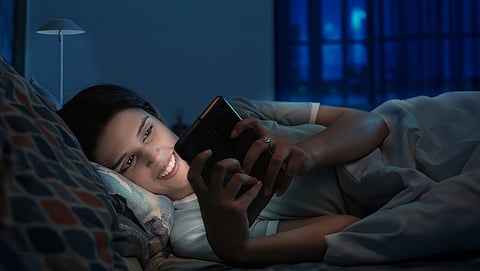

Scrolling at Midnight? Your Phone Is Secretly Ruining Your Sleep
Credit: istockphoto

Scrolling on your phone before bed might feel harmless, but the blue light from screens is quietly sabotaging your sleep. Blue light tricks your brain into thinking it’s still daytime, suppressing melatonin, the hormone that makes you sleepy. The result? Delayed sleep, restless nights, and groggy mornings. Over time, this disruption affects focus, memory, mood, and even long-term health, from metabolism to heart function.
It’s midnight, you’re tucked into bed, and instead of drifting off, you’re scrolling through Instagram, watching reels, or checking one last email. Harmless, right? Not really. That glowing screen in your hand is quietly sabotaging your sleep, thanks to something called blue light.
Blue light is part of the visible light spectrum, and it’s everywhere, for example, sunlight, LED bulbs, laptops, and of course, your phone. During the day, it’s actually a good thing. It keeps you alert, boosts your mood, and helps regulate your body’s natural clock.
But at night? That’s when it becomes a troublemaker.
Your brain has a built-in sleep timer called the circadian rhythm. Think of it as your body’s internal clock that tells you when to wake up and when to wind down. As evening sets in, your body starts producing melatonin, the hormone that makes you feel sleepy.
But here’s the catch: blue light from your phone mimics daylight. When you stare at your screen before bed, your brain gets confused. It thinks, ‘Oh, it’s still daytime, better stay awake!’
Melatonin production slows down, and suddenly, you’re wide awake, wondering why you can’t fall asleep.
Some studies suggest a link between exposure to light at night, such as working the night shift, to diabetes, heart disease, and obesity. That's not proof that nighttime light exposure causes these conditions; nor is it clear why it could be bad for us.1.
Missing out on melatonin doesn’t just delay sleep, it messes with the quality of your rest. You might toss and turn, wake up more often, or miss out on the deep, restorative stages of sleep.
And when your sleep is shallow, your brain doesn’t get the reset it needs.
The next day, you feel groggy, unfocused, and maybe even cranky. Long-term, this pattern can lead to bigger issues: poor memory, reduced attention span, and even mood swings. Some studies suggest that chronic sleep disruption is linked to anxiety and depression.
So yes, that late-night scroll can have ripple effects far beyond a single restless night.
Blue light doesn’t just mess with sleep; it messes with your brain’s performance. Short bursts of blue light during the day can sharpen memory and focus, but at night, it overloads your system.
Your prefrontal cortex, the part of your brain that handles decision-making and attention, gets overstimulated. That’s why you might find yourself endlessly scrolling, unable to ‘just put the phone down.’
Over time, this overstimulation can leave you mentally drained. Think brain fog, slower reaction times, and difficulty concentrating. Not exactly the recipe for a productive morning.
You don’t have to ditch your phone completely. A few small changes can make a big difference:
1. Screen curfew: Try putting your phone away at least an hour before bed.
Night mode: Most devices have a ‘Night Shift’ or ‘Blue Light Filter’ setting, search for it and use it.
Warm lighting: Swap harsh white bulbs for softer, warmer lights in the evening.
Tech-free rituals: Replace scrolling with reading, journaling, or meditation.
Blue-light glasses: If you absolutely must use screens late, these can help reduce exposure.
Reference
Harvard Health | Heart diseases
At marvelof.com, we spotlight the latest trends and products to keep you informed and inspired. Our coverage is editorial, not an endorsement to purchase. If you choose to shop through links in this article, whether on Amazon, Flipkart, or Myntra, marvelof.com may earn a small commission at no extra cost to you.