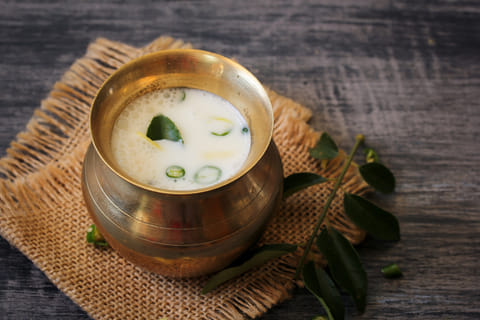

Foods like butter milk are simple, cost-effective ways to stay resilient against rising temperatures.
Photo Credit: istockphoto

Ayurveda identifies summer as Pitta season, marked by heat, acidity, and fatigue. Its remedies are simple, everyday foods with cooling potency: coconut water, cucumber, buttermilk, watermelon, amla, and fennel water. These natural choices hydrate, soothe inflammation, aid digestion, and balance internal fire. Modern research now confirms this age-old wisdom as effective against heat stress.
Walk through any Indian kitchen in May-June and you will find - a pot of kokum sharbat cooling on the counter, buttermilk being churned before lunch along with and a bowl of sliced cucumber. Nobody calls it Ayurveda. It’s just what you do when summer arrives.
But it is Ayurveda. Every bit of it.
This ancient system of medicine that has governed Indian food habits for over 5,000 years considers summer as the season where Pitta, the body’s fire element , is rampant.
More than just being hot, too much Pitta manifests as irritability, acidity, skin flare-ups, lack of sleep and a bone-deep fatigue that even an air cooler cannot cure. The remedy according to Ayurveda is not cold water or ice-cream. It's specific foods that have sheeta veerya or a cooling potency- that works from within.
Take a look at some of the best:
Even before sports drinks were ever conceptualized, coconut water performed all the duties of a replenisher. The drink has one of the finest Pitta preventive attributes in Ayurveda. Modern science only supported what the system preached over 5000 years ago.
It replenishes lost minerals and supports the kidneys. It rehydrates at cellular level. Unlike plain cold water or sweet drinks that have been shown to negatively impact our agni or digestive fire, the tender coconut water we consume is always beneficial.
Always drink it at room temperature or slightly cool. Never straight out of the fridge. The ancient system is emphatic about iced anything, while it satisfies in the short term, it is actually considered detrimental for the internal body fire in the long term as it harms digestion.
Ayurveda categorizes cucumber as one of the coolest foods available, which reduces internal inflammation and soothes Pitta, while simultaneously providing the body with a hefty dose of hydration due to its near-95% water content.
You can have it sliced and seasoned with a sprinkle of black salt and cumin powder, added to a bowl of raita, or simply consumed on its own as a mid-afternoon snack.
Keep the peel on - its highest concentration of cooling compounds is to be found here. Simply ensure you wash the cucumber well before consuming. It doesn’t need to be exotic or dramatic to be beneficial.
Ask any Ayurvedic practitioner about a food to recommend through summer, and you’ll most probably receive a recommendation for buttermilk or Takra.
This isn’t simply cultural lore. Studied have found that Takra is packed with beneficial bacterial strains, particularly Lactobacillus, which acts as a natural probiotic, aiding digestion, supporting immune responses and a balanced gut microbiome. 1
It’s the lack of bad gut flora, which is linked to a number of health conditions and an improper ratio of good gut flora versus bad (which Ayurveda believes should be 85:15), that Takra can help with.
The beverage has a natural way of supporting the body's internal equilibrium, cooling it while helping it recover from sluggishness in summer with the aid of probiotics.
During summer, when digestion is slow and appetite unpredictable, Takra provides a cool beverage that stimulates the digestion while aiding the system’s ability to rehydrate.
Takra can be prepared easily with a cup of yoghurt diluted with water blended with a teaspoon of roasted cumin powder, rock salt and a sprinkle of curry leaves or mint.
Composed of over 92 percent water, watermelon naturally quenches thirst, provides the body with needed glucose lost through sweating, while remaining cooling in Ayurvedic terms, and most importantly, it doesn't inflame Pitta, which is why most sweet fruits are discouraged in summer, except for watermelon.
It is best consumed ripe and fresh, on its own, in the late morning or in the late afternoon. Avoid consuming watermelon on its own after meals, or mixing it with other foods, it can upset your internal equilibrium as it takes a long time to digest on its own.
Salty foods paired with watermelon are a recipe for disaster in the eyes of Ayurveda.
Although less talked about outside wellness circles, amla is a powerful remedy for summer days, one of the richest natural sources of Vitamin C with the added benefit that it is stable at higher temperatures unlike synthetic Vitamin C, and is very easily bioavailable.
It's one of the few foods prescribed by Ayurveda as good for all three doshas, but especially for summer due to its Pitta-pacifying properties.
It calms the heat, balances internal acidity, strengthens the liver (which is particularly affected by the summer heat), and cools the system from within.
Amla can be consumed raw, made into a murabba, juiced with honey or taken in powder form with warm water in the morning.
Fennel seeds, steeped overnight and consumed in the morning, are one of the simplest Ayurvedic cooling strategies that don't usually find a place in everyday summer preparations.
Fennel is described as sheeta in Ayurveda; its cooling nature works by soothing internal inflammation and supporting digestion to balance Pitta.
It is a mild drink that doesn’t work as quickly as coconut water, for example, but it aids with reducing bloating while having a profound effect at reducing internal body heat, in a way that the traditional science says takes some time to work from within.
It costs very little and is ready within 30 seconds of preparing the night before; perhaps this is why it doesn't receive marketing in the way other drinks do.
A 2025 paper published in Frontiers in Pharmacology, the product of research at the Indian Council of Medical Research’s National Institute of Traditional Medicine-specifically mapped out overlaps between the conventional Ayurvedic approach to seasonal food consumption and contemporary methods to prevent and manage heatwaves.2
The paper confirmed that beverages such as tender coconut water, buttermilk, cucumber, and even vetiver root extract, which Ayurveda has been using to tackle summer heat for centuries, perfectly match current recommendations for electrolyte replacement, hydration, and enhancing heat resilience.
Researchers cited the cost-effectiveness, local availability and easy consumption as reasons behind the wide applicability and long-term potential of these food items, especially considering the increase in frequency and intensity of heatwaves.
It’s a subtle, quiet acknowledgement of the age-old wisdom-the old advice was right all along.
It doesn't take a complete change of lifestyle, or a consultation with an Ayurvedic doctor, to adopt some of these food habits.
Take it one or two items at a time. Swap your usual cold drink for a glass of Takra. Stock your fridge with sliced cucumbers. Add some soaked fennel water to your routine. Drink coconut water whenever you'd typically grab a packaged drink.
The summer heat will descend on us regardless of how prepared we are-these are Ayurveda's way of saying: Be ready.
How does Ayurveda recommend managing summer heat differently than conventional cold drinks?
Ayurveda emphasizes cooling foods with 'sheeta veerya' (cooling potency) to balance Pitta, the body's fire element. Unlike cold water or ice-cream, which can harm digestion, Ayurvedic remedies such as coconut water, buttermilk, cucumber, and fennel water cool from within without disrupting the digestive fire.
What are the key benefits of drinking buttermilk (Takra) during summer according to Ayurveda and modern research?
Buttermilk (Takra) acts as a natural probiotic, containing beneficial bacteria like Lactobacillus that aid digestion, support immune responses, and maintain gut balance (optimal ratio of 85:15 good to bad flora). It cools the body, stimulates sluggish digestion, and helps rehydrate effectively in hot weather.
Can I effectively incorporate these Ayurvedic cooling foods without consulting a specialist or drastically changing my lifestyle?
Yes. The article recommends simple steps like swapping cold drinks with Takra, keeping sliced cucumbers handy, drinking coconut water at room temperature, and having fennel water steeped overnight. These easy-to-adopt habits do not require major lifestyle shifts or Ayurvedic consultations.
How do Ayurvedic summer cooling foods compare in cost-effectiveness and accessibility to conventional heat management methods?
According to a 2025 study by the Indian Council of Medical Research, Ayurvedic foods like tender coconut water, buttermilk, and cucumber are cost-effective, locally available, and easy to prepare. These factors enhance their long-term potential for managing heatwaves compared to costly packaged or synthetic options.
Is it safe to consume these Ayurvedic cooling foods cold or directly from the refrigerator?
Ayurveda advises against consuming these foods too cold or iced, as extreme cold harms the digestive fire (agni). For example, coconut water should be drunk at room temperature or slightly cool, never straight from the fridge, to ensure internal balance and effective cooling.
References:
1. ResearchGate|Buttermilk (Takra) for Gut Health: A Review from the Standpoint of Ayurveda
2. National Library of Medicine | Integrating traditional and herbal medicine into heatwave resilience and care
Disclaimer: This content is for general informational purposes only and should not replace professional medical advice. Always consult a qualified healthcare provider with any questions about your health or treatment options.
At marvelof.com, we spotlight the latest trends and products to keep you informed and inspired. Our coverage is editorial, not an endorsement to purchase. If you choose to shop through links in this article, whether on Amazon, Flipkart, or Myntra, marvelof.com may earn a small commission at no extra cost to you.