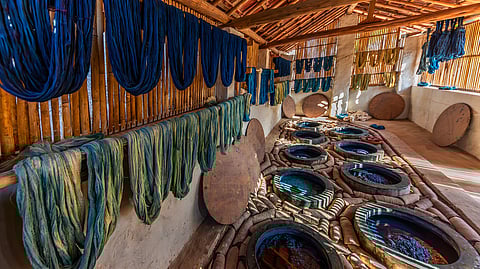

From indigo blues to madder reds, explore Ajrak dyes, their process, meaning, sustainability, and why natural dyes define this timeless craft.
Photo Credit: iStock Image

Ajrak dyeing is a complex, layered process rooted in natural materials and time-honoured techniques. This article breaks down how each Ajrak colour is created, how long the process takes, and how it differs from synthetic dyeing. It also explores the environmental impact of modern textile dyes and why Ajrak remains a sustainable alternative.
Born from the arid landscapes of Kutch and shaped by traditions that traces back to the Indus Valley Civilization, Ajrak is more than a textile, it is a living memory of craft. In a land where water is scarce and nature dictates rhythm, artisans learned to work with the environment, not against it.
Every Ajrak fabric begins as a blank canvas, but what transforms it is not just pattern, it is color. Deep indigos, earthy reds, and soft blacks are not merely visual elements they are stories of soil, sky, and time.
Each dye is prepared with care, applied with intention, and developed through a process that can take weeks. In Ajrak, color is not added, it is earned with paitence.
Dyes are central to the identity of Ajrak. Unlike industrial printing, where colors are quickly applied and things are made in commerical quantities. Ajrak relies on a layered dyeing process that involves multiple stages of resist printing, washing, and re-dyeing. Each color interacts with the fabric differently, requiring precise timing and environmental conditions.
Natural dyes are derived from plants, minerals, and organic sources. These dyes do not just sit on the fabric, they bond with it, allowing the colors to age gracefully over time rather than fading abruptly.
Ajrak has a very limited color palette yet it is deeply expressive. Each piece of fabric is created entirely from natural sources. Each shade is developed through time-intensive processes, giving the fabric its signature richness and depth:
Indigo (Blue): Extracted from indigo leaves, this is the most defining Ajrak color. Built through repeated dyeing and oxidation, it creates deep, layered blues associated with the sky and vastness.
Madder Root (Red): Sourced from plant roots, this produces warm, earthy reds. The dye requires controlled heating and careful treatment to achieve consistency and vibrancy.
Iron Black: Made using fermented iron filings, jaggery, and water, this dye forms the bold outlines that structure Ajrak patterns and enhance contrast.
Turmeric (Yellow): Derived from haldi, this natural dye introduces warm yellow tones. While not as dominant as indigo or red, it is often used in combination with other dyes to create softer hues and subtle highlights.
Resist White: Not a dye but a technique, where areas are protected using resist paste to retain the base fabric color, adding contrast and definition to the design.
Together, these elements create a balanced palette that reflects both the environment and the cultural philosophy behind Ajrak, where every color has a purpose and every shade evolves through process rather than instant application.

Ajrak fabric is dried and reprinted multiple times to create inticrate patterns.
Photo Credit: iStock Image
The Ajrak dyeing process is intricate and time-intensive, often taking 14 to 21 days, and in some cases even longer depending on complexity.
Fabric Preparation: The cloth is washed multiple times to remove impurities and soften fibers.
Mordanting: The fabric is treated with natural mordants like alum to help dyes bind effectively.
Block Printing with Resist Paste: Using hand-carved block printing blocks, artisans apply resist paste to define areas that should not absorb dye.
First Dye Bath (Indigo or Base Color): The fabric is dipped into dye vats of base colours, often repeatedly, to build depth of color.
Drying and Reprinting: After drying, additional layers of printing and dyeing are done to create complex patterns.
Final Washing and Finishing: The fabric is washed in flowing water and sun-dried, allowing the colors to fully develop.
Each stage in Ajrakh demands precision, if the artisan does one mistake it can ruin the entire piece and his efforts.
Indigo first appreas green when fabric is dyed and gradually turns blue. Representative Image Only.
Photo Credit: iStock Image
Natural dyes demand patience, and Ajrak is built on that slow transformation. Indigo is fascinating dye, it first appears green when the fabric is dipped, then gradually turns blue as it oxidizes in the air. This visible shift is a reminder that color in Ajrak develops over time, not instantly.
Red from madder root requires controlled heating to achieve depth and consistency, making the process equally precise.
Turmeric used for yellow tones is prepared by soaking powdered haldi in hot water with agents like baking soda and lime. To enhance brightness and longevity, ingredients like pomegranate rind and alum are often added. It can also be layered over indigo or red to create greens and oranges.
This is why Ajrak fabrics cannot be mass-produced quickly. Every shade is layered, tested, oxidized, washed, and refined over several days and sometimes weeks, resulting in a richness and depth that synthetic dyes rarely achieve. In Ajrak, color is not simply applied, it is carefully developed to tell you a story, allowed to breathe, and given time to become part of the fabric.
Tumeric dyed fabric turning yellow. Representative Image Only.
Photo Credit: iStock Image
The difference between natural and synthetic dyes extends far beyond visual appeal while the syntheic look more brighter and natural dyes more duller. The major difference lies in their impact on the environment. Natural dyes, used in Ajrak, are biodegradable, skin-safe, and develop depth over time through layered processes. Whereas, synthetic dyes are chemically engineered for speed and uniformity, but this efficiency comes at a cost.
In the Indian textile sector, studies show that up to 10–15% of synthetic dyes fail to bind with fabric and are released into wastewater, contributing significantly to pollution. Additionally, textile dyeing is a major contributor to water contamination, with high levels of chemical oxygen demand (COD), heavy metals, and toxic residues found in discharged effluents. 1
Synthetic dyes are often non-biodegradable and persist in water bodies, disrupting ecosystems and causing risks to human health. Natural dyes, while slower to produce, align with ecological cycles, making Ajrak not just a craft, but a sustainable alternative rooted in responsibility.
Natural dyes bring a certain unpredictability that adds character to Ajrak. No two pieces are exactly alike, as variations in temperature, water, and dye composition influence the final result.
This uniqueness is what gives Ajrak its soul. Each fabric carries subtle differences, making it not just a product, but a piece of living craft shaped by human hands and natural forces.
Ajrak dyes are not just about color, they are about time, patience, and harmony with nature. In a world driven by speed and mass production, Ajrak stands as a reminder that true beauty cannot be rushed. Every shade, every layer, and every motif reflects a process that values craftsmanship over convenience.
Choosing Ajrak is not just a style decision, it is a conscious choice to support a tradition that respects both culture and the environment.
What distinguishes natural Ajrak dyes from synthetic dyes in terms of environmental impact?
Natural Ajrak dyes are biodegradable, skin-safe, and align with ecological cycles, causing minimal pollution. In contrast, synthetic dyes are chemically engineered, often fail to bind completely with fabric, and release toxic substances into water, causing heavy metal contamination and ecosystem disruption.
What are the main natural dyes used in Ajrak, and how do they contribute to its unique palette?
Ajrak primarily uses indigo (blue), madder root (red), iron black, turmeric (yellow), and a resist white technique. These natural dyes create rich, layered colors that evolve over time, giving Ajrak fabrics their signature depth, earthy tones, and cultural symbolism.
What role does the resist paste play in the Ajrak dyeing technique?
Resist paste is applied via hand-carved blocks to protect specific fabric areas from absorbing dye during each stage. This technique defines patterns and preserves the base fabric color to create contrast and intricate designs unique to Ajrak textiles.
Can Ajrak fabrics be mass-produced quickly like synthetic dyed textiles?
No, Ajrak fabrics cannot be mass-produced quickly because the natural dyeing process is time-intensive, requiring multiple washes, prints, and dye baths over weeks. Each step demands artisan skill and patience, ensuring the fabric’s richness and sustainability, unlike the rapid application of synthetic dyes.
At marvelof.com, we spotlight the latest trends and products to keep you informed and inspired. Our coverage is editorial, not an endorsement to purchase. If you choose to shop through links in this article, whether on Amazon, Flipkart, or Myntra, marvelof.com may earn a small commission at no extra cost to you.